

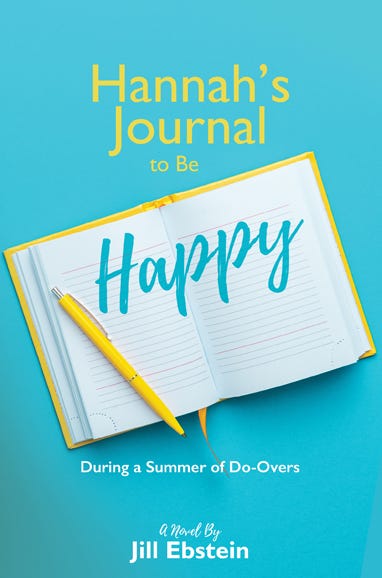
Hannah’s Journal
My name is Hannah, and I just published a book, which is actually a journal. I wanted to be happier. I read somewhere,
Write your piece. Find your peace.
I figured it would work if I journaled my way towards peace.
I’ve been speaking a lot lately about what I learned. Synagogues, churches, school, and even my chess club, want to know my discoveries when I spent a summer in Terre Haute, Indiana. Last summer, I hung out with my brother, dad, and my dad’s girlfriend in Terre Haute, which is a low-key place where almost nothing happens.
Perfect for journal writing and thinking.
Here are my top four personal lessons that I think will make a difference in my happiness factor. Trust me — there are more.
Lesson 1: Reduce the need for perfection. It’s a burden.
I like my world to be precise and organized. Probably most people would prefer that, but I work to make it happen. I understood how much I’m a perfectionist when my dad announced we would have to make our beds each morning.
How do I make my bed? Like this:
I make sure that the sheet is the same length on both sides. I smooth out all the wrinkles. I add hospital corners so that the sheet doesn’t come loose. The top of the sheet is folded 6 inches before I tuck in the sides. That way, it comes right up to my shoulders — so high enough but not too high. I add the comforter. Same rules apply about equal length on both sides. I fluff up my pillow, put the teddy bear right smack in the middle, and voila!
My brother does none of that and doesn’t understand why you would fluff up your pillow when it’s just going to go “poof” the minute you lie down. He has a point.
I am now going to work on not being such a perfectionist so that I can relax more.
I am going to call this change of attitude “Hospital corners not.” I see this as a stretch goal.
Lesson 2: It’s important to have a healthy ego, which should not be confused with arrogance.
My dad and I were watching Jeopardy one night. I ran the column on “literature,” which isn’t surprising. I love books, and I love to write. When I’m an adult, I hope to be a well-read author.
When we were playing, my dad became ornery and said, “How is it that my 15-year-old daughter knows more than me?” and then he stomped out. I felt bad.
I wasn’t surprised that my dad didn’t know “literature” because he’s not a big reader, and when he reads, it’s magazines like Popular Mechanics or one I’ve noticed dog-eared and read many times, Family Handyman.
So I asked Ben, my wise 12-year-old brother, what he thought about the Jeopardy episode, and Ben said a few smart things. He told me it wasn’t my fault I knew so much.
“You weren’t born knowing all this. You worked for it. I see how much you read. Sometimes, I am only pretending to read while I watch you.”
And then he added,
“Dad simply has to raise his game if he wants to beat you in Jeopardy. He needs to read more than magazines.”
This all made me wonder whether my ego was too big. Do I need to reign it in?
Ben told me, “No,” LOUDLY. Ben is all about tennis, and so he explained using the way he understands his world,
“If you don’t believe you can do something, you probably can’t, which makes having a healthy ego very important. That’s why I bring ego to my tennis game.”
Case closed. A healthy ego will allow me to do more. I will back up my ego with action.
Lesson 3: Honesty is not always the best policy. Tender honesty is the way to go.
I learned this lesson a few times this summer. My dad asked me if I had “connected” with his girlfriend, Lucy, and whether I liked her.
At the time, I didn’t know her very well, and I didn’t like her, but instead, I said, “If she makes you happy, that’s what matters.”
My dad called that a “lukewarm endorsement” and appeared hurt. If he asked me today, he knows he would get an emphatic “yes.”
But the story has made me consider whether honesty is really the best policy. Here’s another example:
I have been encouraging Ben to write, and because we are in Terre Haute with time on our hands, he actually has. Now, if Ben writes something that’s silly and makes no sense, do I tell him, “This seems stupid,” or do I say,
“Just keep working on your idea. The best things take time.”
See what I mean? We can be honest but there needs to be some gentleness applied.
I’ve never been gentle when it comes to feedback, but now I know that it really makes a difference.
Lesson 4: It’s important to leave our comfort zone if we want to grow. It’s also hard to do.
My dad asked us to make a special birthday dinner for Lucy. Ben and I had very different opinions of the menu. Here was Ben’s and my conversation:
Me: We don’t have much time, and we need something solid. I vote for spaghetti and meatballs as the main.
Ben: Hannah, did you not hear Dad’s words, “This needs to be really nice.” Spaghetti and meatballs are everyday food. We need something like coq au vin or braised beef tips.
Me: So, when did you become Julia Child? We don’t know how to make those fancy dishes, and anyway, we need something low-risk.
Ben: We know how to read and use the Internet. We’ll be fine.
I could see that I wasn’t going to win this, so I agreed to coq au vin, which sounded fancier, and anyway, I like chicken better. There were other menu items to figure out. For appetizers, I suggested a cheez whiz dip with fresh veggies.
“Why even bother with anything fresh when you’re going with Cheez Whiz?” asked Ben.
He countered with deviled eggs, which he said he knew how to make. He won that one, too.
So this all got me thinking about the difference between Ben and I had to ask about his willingness to not play it safe. This conversation followed.
Me: Ben, do you ever struggle to get out of your comfort zone?
Ben: I don’t think I understand the question.
Me: Do you ever force yourself to do things you don’t feel that comfortable with when there is something easier you could do instead? For example, we could have made spaghetti and meatballs, but instead, we are making some fancy French dish that we can’t even pronounce.
Ben: Oh, the way I would say it is, “Do you ever go for broke on your second serve?” In other words, I have a safe serve that lands in the service box but wins me no points. I have a spin serve that lands in maybe 40 percent of the time but is a winner. Which do I choose? Safe or something exciting but might also fail?
Me: That is a good way of translating my words into “Ben-speak.” So, what’s your answer?
Ben: I always go for broke. Otherwise, how will I get better?
These four insights are major for me. To summarize (because I like order and organization):
I am going to be less of a perfectionist. I call it “Hospital corners not.”
I am going to appreciate that I have ego. I am not arrogant. I am capable.
I will continue to be honest but apply some tenderness to my words.
I will leave my comfort zone sometimes — especially if Ben is nearby.
These four lessons are a start in helping me to reshape my attitude and what I call the “happiness factor.”
I am going to live life on the sunny side for a change, and it will be fun.
Signing off,
Hannah
Hello!
I love the voice here. It is fascinating to compare this to your recent beautiful entry on your four days of family time, from the 60-something early rise, to the "Mom's what for dinner" and the aftermath. Looking forward to reading more of these two voices!
Maureen M.