
Explaining Alfred
Neurodivergence is only a word, and Alfred is a person

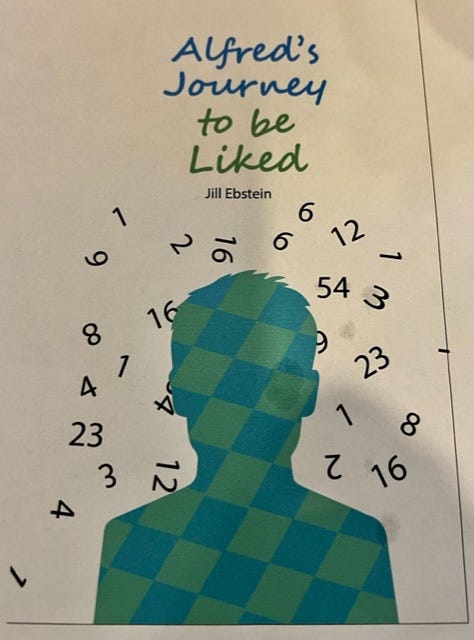
Note: My first experience writing fiction was creating a character named “Alfred” who, I was later to learn from the many therapist-readers, was neurodivergent. I protested their label and explained that he is “quirky” like we all are. Yes, he loves numbers, and no, he doesn’t want to hug you, but that describes many people and doesn’t make him neurodivergent. I am still not a “confirmed” believer that Alfred is neurodivergent, but I concede I understand the designation. To me, it matters not.
Alfred’s mom decides she needs to find him a coach, so that he has friends. The excerpt below describes the moment when she realizes she wants to help Alfred more actively. Alfred’s grandmother speaks truth and is a huge, positive influence, as you will see below. I believe most parents have moments they worry about their children, and if we’re lucky, there is a grandparent in the room to steady us.
The image in this piece is the one I rejected because it didn’t do justice to Alfred’s many layers and huge heart.
And now, the excerpt from Alfred’s Journey to Be Liked.
Alfred’s mom thought about how she would explain “Alfred” when the time came.
She recalled her many conversations with Alfred’s teacher, Ms. Baker. She had wanted to know whether Alfred had any friends. Did he seem engaged at school? Did Alfred look happy? She couldn’t help but worry whether Alfred “belonged,” and if not, what could they do?
Ms. Baker had been helpful. She always was. She understood Alfred for all his good and all his quirky ways. Alfred’s mom could still hear Ms. Baker’s words when she asked,
“Eleanor, is it you who worries about Alfred, or does Alfred worry about Alfred?”
Eleanor knew the answer. She worried about Alfred. When her pediatrician had suggested that “Alfred might be somewhat autistic,” Eleanor went straight to Google to learn what that meant. The more she read, the better she understood both herself and Alfred.
They were, by design, very literal. They liked alone time. They would never be the life of the party.
For them, the party was playing chess and eating popcorn.
She had found comfort in the pediatrician’s use of the word “might.” How would they know? Were there degrees of behavior? Would it change the course of Alfred’s life? For all these questions and more, the pediatrician shared that yes, there were degrees, and at least as Alfred was concerned, if he was on the spectrum, he seemed to be functioning at a high level.
He went to school, did well, had interests he truly enjoyed, could talk to people as needed, and seemed overall happy.
“I tell you this, just so you are aware, in case it becomes a challenge as Alfred matures. It is the kind of thing I’d keep my eye on but not get too, too focused on.”
All this made sense, but then Eleanor did what she usually did when she felt nervous. She went to her mom. Her mom was smart, thoughtful, and had been around the block.
Plus, she was their biggest champion.
“Ellie,” her mom said,
“You weren’t so easy either, but look how you turned out. I wouldn’t worry too much. Anyway, you and Alfred are a lot alike. If it makes you feel better, find someone who can work with Alfred. They do so much more these days than when you were growing up. But you’ll see. Alfred will be fine. Even better than fine.”
She added,
“He’ll be great. By the way, I think he’s great now.”
It took Eleanor three months until she found just the right guy. Tom had a quiet presence. He didn’t say much, but every word counted. When she told Tom about Alfred — that he’d be resistant, that he was very literal, that he wouldn’t see the point in working on anything that seemed “soft” like interpersonal skills — Tom just shook his head with a knowing kind of nod.
“I’ve been there before. I think we can give it a go and see how it lands.”
Eleanor waited for Tom to elaborate, but he didn’t. Instead, they shared an awkward silence. Then, to ease the pain of the moment, they both started talking, and then they stopped simultaneously. More awkwardness, and then laughter. Eleanor finally began,
“Well, you’ve got me laughing, so that’s a good sign. Ok, I’ll start, Tom. Let’s give it a go, as you say. But I’d like to refer to you as ‘Coach.’ For one thing, it’s what you’ll be doing. And for another, Alfred has a hard time remembering names.”
Tom smiled. “I like Coach better anyway. It could become my new moniker. I should have thought of it myself.”
And that was that. All was set. Next week would be Coach and Alfred’s first meeting. It was now time for fate to take its course. Eleanor had done her job.
I really like the way you keep Alfred at the center instead of any label. Every child deserves to be seen first as a person, and this story does that with real warmth.