
The Words That Stayed
How one quiet conversation changed the course of my life

Some of the biggest turning points in my life barely registered when they happened.
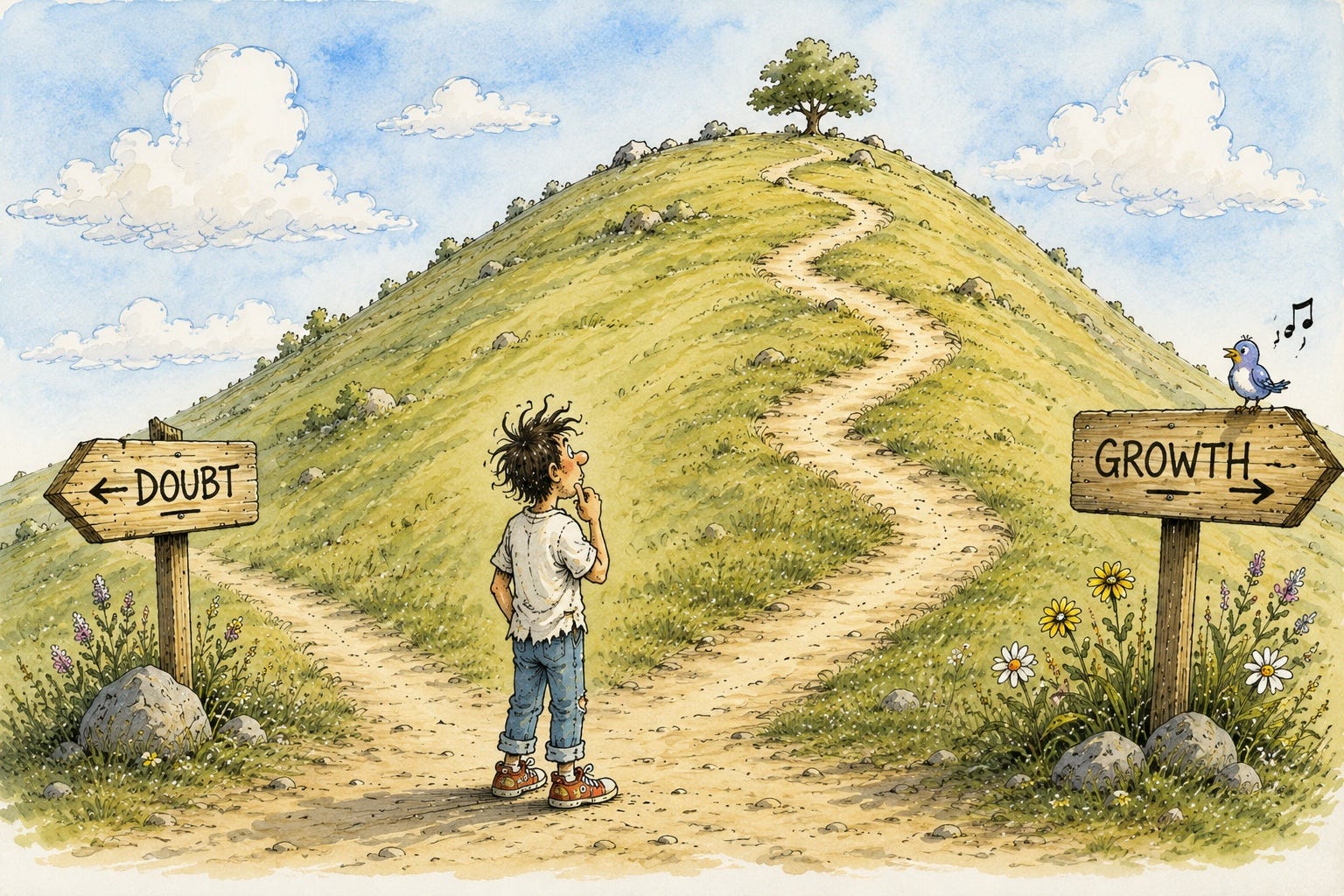
Looking back, I can now identify three that changed everything. They also help explain a note I wrote that sits on my desk:
“Growth is on the other side of doubt.”
Its purpose is to remind me that when I am about to undertake something that feels significant, and my knees get wobbly, I should push through.
I mostly do.
So about those turning points that would shape my life and feature prominently in my path toward writing fiction, here are three such moments.
Inconsequential moment number 1: My dad’s simple words
I had graduated from college with no clear plan. Well, my parents would edit that sentence to read “with no plan.” I was going to Boston to help Ted Kennedy make national health care happen. Of course, he had no idea who I was. Only someone fresh out of college, with no real sense of their capabilities or the walls that block progress, could think this.
Before heading to Boston, I came home to Denver. I met my new baby niece and also took notice of the glorious Rocky Mountains. They became the perfect metaphor for what I was about to attempt. I was going to scale the steep climb of health care policy in Boston, without knowing anyone or almost anything.
At the family gathering where we welcomed this one-week-old baby, my father took me to a quiet corner and said the following.
“You don’t have to prove anything to anybody. If it doesn’t work, come home with your head held high. Just say the word, and I will send you a ticket.”
My parents had reason to be worried. I had no money, no experience, and no connections. I also wasn’t mature enough to appreciate what I lacked. A friend of my brother’s lived in Boston and was happy to provide lodging. Wasn’t that enough?
It didn’t take long for me to recognize I had an overblown notion of what I could do in the health policy space — just one trip into Kennedy’s office, where I found that only unpaid interns were brought in.
Thus began my first real pivot. I found a job at Massachusetts General Hospital (MGH), where I supported a group that was building MGH’s first ambulatory care site. In 1979, ambulatory care was a vague, foreign concept that we were hoping to make concrete.
The group was comprised of three smart women who allowed me to barter my administrative/secretarial skills for training in health care analytics. We were the planning arm of MGH’s Wang Center, their flagship organization that would be delivering care differently. I learned, and grew, and even landed in the health care policy space, before I went to business school.
But my dad’s words, which seemed sweet and almost benign when he said them two years earlier, were anything but. They became my chorus for doing anything that required guts:
“You don’t have to prove anything to anybody.”
As if to amplify his message, I added: “Growth is on the other side of doubt.”
Inconsequential moment number 2: Rosabeth Moss Kanter speaks
It was post-business school, post-consulting, and I was working at Hewlett Packard (HP). They had brought in Rosabeth Moss Kanter, a renowned professor from Harvard Business School who spoke about leadership.
She was articulate, but honestly, said very little that would connect with individual contributors like myself. When she was done speaking, I walked out disappointed — not with Kanter, but because I still hadn’t heard someone speaking to people like me.
Suddenly, I felt compelled to write something that could be a thought-provoking source of support for individual contributors. Could we learn to steer our own careers? The leaders were too busy to help figure this out, and Kanter’s words weren’t going to help.
Another seemingly inconsequential moment…
Months later, I had a working draft of a book I titled Little Fish, Big Ponds. I didn’t realize how little I knew about writing and publishing, but a published friend gave me a name — Helen Rees (she founded Reese Agency) to speak with. Helen liked my idea because she had been the agent behind Michael Hammer’s reengineering craze, and she worried about the people who were reengineered out of their jobs. She found my message helpful and inspiring.
Rees sent my proposal and draft chapters to two publishers, both of whom thought the idea had legs. Now all they needed was a platform to work with. What did I have?
I didn’t even know what a platform was. I was told to go develop one and come back.
Case closed.
But what did I say to myself? Those words of my dad’s…
“You don’t have to prove anything to anybody.”
I focused on my day job and went on break from writing. I was fine, even if I felt defeated.
Inconsequential moment number 3: Sheryl Sandberg and Lean In
When Sheryl Sandberg’s book Lean In: Women, Work and the Will to Lead went viral, I had a strong reaction. The book celebrated women driving fast on the autobahn as they sought to achieve new career heights. I saluted them, but I was on a carriage road, going at my pace.
I wasn’t leaning in, and Sandberg’s story was not for me. I was optimizing the mix of work, family, and side interests. I was not breaking down barriers.
As hard as I looked, I simply couldn’t find a book that celebrated my view. I decided this would be my next writing effort. There were many women like me — women who didn’t adhere to monikers but instead created an authentic, low-to-no-shine path that worked for them.
I could help those who had a story to share but felt they lacked writing skills.
At My Pace: Ordinary Women Tell Their Extraordinary Stories was born in 2015.
Two more books would round out the series — one on Lessons from Our Mothers, and one on Twenty-somethings Finding Their Way. Each book was a compilation of short pieces by various authors, selected and edited by me, and then I self-published.
Why self-publish? I still lacked a platform, and I wasn’t about to become rejected for a series I believed in. Ten years later, I continue to love the series and what it taught me and others.
Those lessons would shape my next phase of writing, which began during Covid when the Alfred series was born.
Each step of the way became a turning point where I learned something significant.
I believe we all have those turning points — moments that can dramatically alter our path. They can be small and quick, so the trick is seeing them and then committing to them.
My dad probably never imagined that one quiet conversation before I left for Boston would become the soundtrack for so much of my life.
Growth is on the other side of doubt.
It’s amazing how a few simple words can quietly shape an entire life. Your dad gave you permission to try without fearing failure. That’s a gift worth carrying.
You are a lucky girl to have had a Dad who said "You don't have to prove anything." And also, "I'll send you a ticket"!!
May I just add - your post hit the spot for me today. As I continue working through the launch of The Kindness Envelope, some mornings I ask myself "What the heck are you doing?" and then others where I say something similar to your words "Growth is on the other side of doubt."
Thanks, Jill.
You are my Jiminy Cricket today!
I'm guessing there are a lot of other writers on Substack who feel the same way.