
When I Can’t Remember Dad’s Voice
But the words still stick

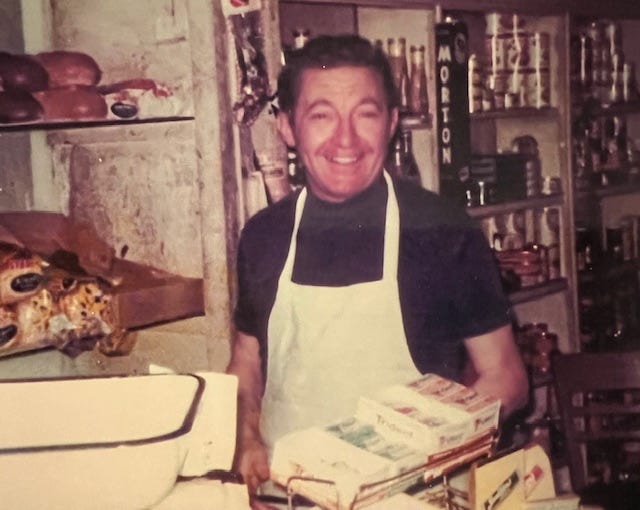
Today marks the 43rd year of my dad’s passing. Stories of my dad have populated my writings for years, and while it is hard for me to still hear his sweet, tenor-sounding voice, the words he spoke remain bold and all caps. “Dempsey,” as he was known to others, is still my keel, steadying me when the waters get turbulent.
On this 43rd anniversary, I want to honor my dad’s memory by sharing one of his lessons, which I have since passed on to my kids.
But first, a few words about my dad’s challenging start in life. His family was very poor. My zayda (Yiddish for grandfather) was in the cattle business. His cattle farm was a two-hour drive away, which he mostly managed from afar.
As I write this, I find humor in considering my zayda a virtual worker in the early 1900s.
Like the story of Joseph in the Old Testament, a book my dad’s family read weekly, some years were good, some years were bad. For their family of seven, money was very tight. At one point, my dad went to the bank on behalf of his parents to plead for leniency in saving their house. He won. His parents were immigrants with limited English language proficiency and would likely have been far less successful at making the argument.
My dad also took on extra work to help provide for the family. A funny aside was that he wasn’t allowed to run a newspaper route — something many kids his age did — because that path was considered to be lined with miscreants who could turn him the wrong way into an immoral abyss.
A much different route was available when his teachers identified my dad as smart and of Rabbinical material. They wanted to send him away to Rabbinical school, but he had to say no to that, too. Family responsibilities weighed heavily on his shoulders.
That was my dad — dutiful, hard-working, capable, and shortchanged on opportunities because his family needed him.
When Dad met my mom, he was 25, and she was 17. To this day, I don’t know how they afforded the wedding, which my bubbie (Yiddish for grandmother) made happen for all of 50 dollars — each set of parents contributing 25.
Mom shared that they had my bubbie’s golden chicken soup so their life would be golden. Not to romanticize the story, but my parents did have a storybook marriage filled with love and, eventually, six kids. They felt blessed, even though they scraped by with meager earnings.
I wouldn’t say we were “poor” because we had a small house, food, our daily newspaper, and many books. We were a well-read family. But there was no “extra,” making my dad’s angst completely understandable.
It was through the adamance and help of my bubbie that my parents bought a house and then a small grocery store. We were to become a grocer’s family. We all learned to serve — whether it was our customers or our parents — and while our lives presented challenges and hard work, we were a happy group that lacked nothing important.
Of the many lessons Dad taught — and there were many — the one that continues to speak loudest to me is,
“What goes around, comes around.”
What could these five simple words mean to my dad?
He wanted us to know that if we treated people with respect and dignity, we could expect the same back. Be kind, and people will be kind to us. Be charitable, and people will extend a helping hand.
This meant that when our customers were short on cash but needed to buy groceries, they could still walk into the store and select whatever they needed. My dad would total it up and then write the amount and the name on a piece of paper torn from the register roll. He would tape it to the side of the register, which would only come down once paid.
Sometimes, there could be many small pieces of paper on our register. Most of the time, people did right by us and paid up. Occasionally, someone who wasn’t a customer but a traveler would come into the store and say they did not have cash “yet.” They were waiting for something to come in, and they typically stayed at the low-cost motel nearby called “The Four Winds.”
Seeing my dad extend credit to someone he didn’t know always felt risky to me. I was in my teens and asked my dad on more than one occasion, “What if he doesn’t come back to settle his debt?”
My dad, virtuous man that he was, would reply,
“Don’t worry. What goes around, comes around. Someone will be this nice to you one day. Live your life believing that the right things will happen.”
For the record, we did get scorched a few times by itinerants who probably never intended to pay. I even think Dad recognized the type, but he never changed his behavior.
I am not sure whether it was Dad’s religious convictions or his overall good nature that led to his generous spirit. He prayed three times a day, very quietly at the back of our store. He went to synagogue on the Sabbath, dressed in his best clothes, making sure he showed respect to God and his community.
Standing by our front door before he exited to the synagogue, he’d wait for us to comment on how he looked. He always looked clean, well-put-together, and ready to pray. We would follow to synagogue much later.
His often repeated 5-word credo was important because he needed his children to understand that we should make our conversation and thoughts about “others,” not about “us.”
His focus on others was what led to a loyal customer base when a large grocery chain was a stone’s throw away. Customers could unload their worries as they talked to Dad and buy groceries on credit. It’s the kind of “value proposition” I would understand years later when attending business school.
But for us, Dad had an important lesson that accompanied his message of what goes around, comes around. Dad wanted to make sure we knew that life spent with our siblings was special and would become more rare as time marched on.
“It will be harder as you get older to see each other,” he’d say, telling us to mark this moment.
At 67, those words hit me almost as hard as “What goes around comes around.” My siblings are my tribe, and my tribe is spread out from coast to coast. We were all strong students who worked to make sure that our lives extended way beyond the grocery store, even if the grocery store was our best place of learning.
This weekend, we will have a Zoom call where we all reminisce about the ways our dad’s lessons prepared us to lead worthy lives. It’s not lost on one of us that no matter how many degrees we’ve earned and work we’ve done, we still yearn to achieve the kindness of our dad.
Tonight, when I say Kaddish, the Jewish prayer of remembrance, I will think back to the day he died and the long trail of people who walked behind the hearse to pay their respects. They knew him for what he was, and they were thankful to have had him in their corner.
This week, Hannukah begins. My father passed away exactly one week before the holiday. He will be on our minds as we light candles and sing songs. “Light One Candle” is one of my favorites. As the song’s chorus goes:
Don’t let the light go out!
It’s lasted for so many years!
Don’t let the light go out!
Let it shine through our hope and our tears.
My dad’s kids, grandkids, and great-grandkids will make sure to shine the light, so that it lasts for many years ahead.
What a lovely tribute to your dad and his parents. I feel the same about my dad. There's a special link between fathers and daughters. I have seen it throughout generations. What a special time of the year. Enjoy!
A touching tribute to your dad - his wisdom and kindness clearly live on through you and your family 💙
Wishing you a happy holiday season, Jill! 🎄✨✨